
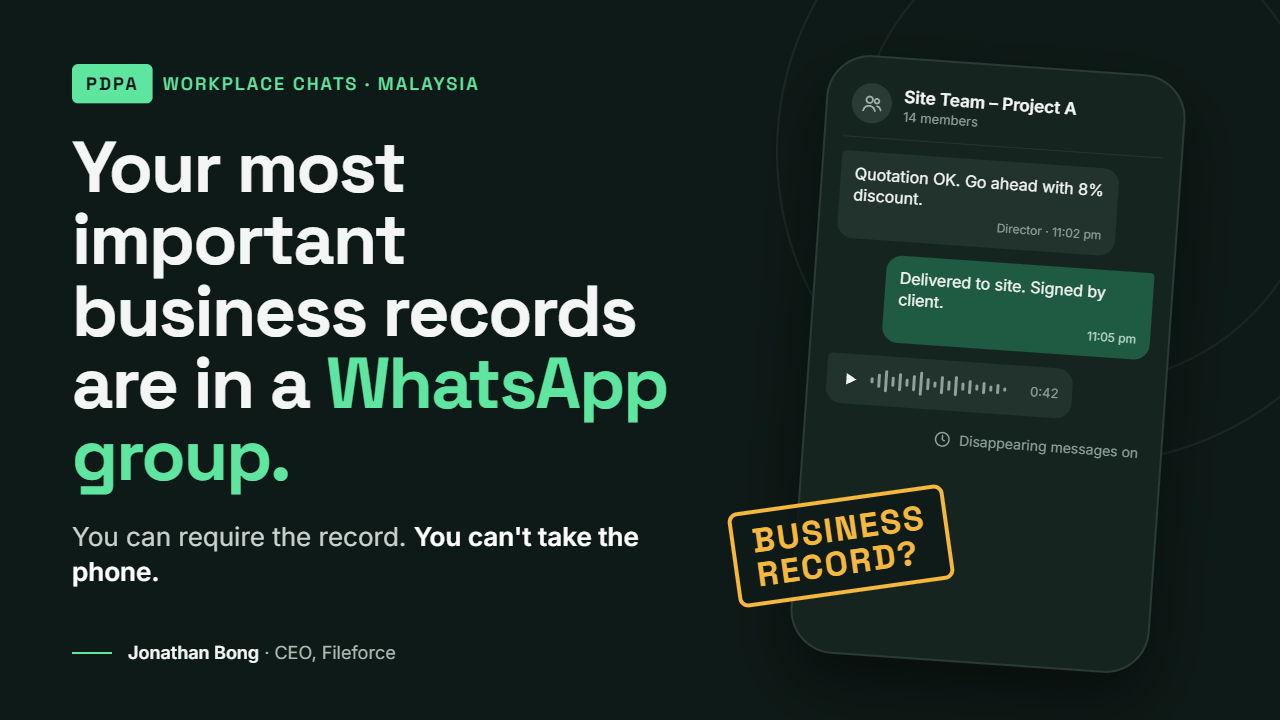
The chat is the record
Most Malaysian businesses do not run
exclusively on email. Instead, many rely on WhatsApp or similar messaging
platforms like Telegram: a quotation agreed in a group chat, a site supervisor confirming
delivery with a thumbs-up, a director approving a discount by voice note at
11pm. Most of it happens on phones the company does not own, using private
numbers it does not control.
In November 2026, John Goff of FTI
Technology opined on AIIM
blog that mobile messaging is now a records problem for every industry, not
just banks. US regulators expect text messages, chat apps and disappearing
messages to be preserved like email. The SEC's off-channel enforcement wave,
which began in 2022, cost financial firms billions in fines.
Reading it, I thought about my countless
BlackBerry devices. Back then the company issued the device, and the company's
BlackBerry Enterprise Server sat in the middle of everything. Email flowed
through it. From version 4.1.2, the server could log PIN messages, SMS and call
details (InformationWeek).
By 2013, regulated firms using BlackBerry Enterprise Server could log and
archive BBM conversations on BlackBerry OS devices, with BlackBerry 10 support
announced for the following spring (Dark
Reading). Not every company elected to log, but the option was there.
Governance was built into the architecture.
Then came the iPhone and Android, the
“bring your own device” debates of the Obama years, and WhatsApp quietly became
the office’s best tool. Business conversations moved onto personal phones,
through messaging apps the company couldn’t administer, protected by encryption
it could not get through. We transformed the channel but not the governance. We
gained speed and convenience — and inadvertently gave up the record. This is
exactly what digital transformation in records management is meant to prevent:
the technology changes, but the accountability, metadata and retention controls
are left behind.
Although Malaysia has not
experienced such a crackdown, we have something
that makes the problem harder: the PDPA, a law
that sits squarely between the employer and the employee's phone. So the question on every
HR, legal and records manager’s
mind is: “Can we make staff hand over work chats that
live on their personal number?”
The short answer is: “You can
require the business record,
but you cannot take the phone!”
The legal backdrop, in brief
Malaysian courts already treat WhatsApp
messages as documents under the Evidence Act 1950, and they carry real weight
in employment disputes. In Mok Yii Chek v Sovo Sdn Bhd (2015), the High
Court held that WhatsApp printouts are "documents" under the Evidence
Act (DNH), and the Industrial Court
has upheld dismissals where the evidence turned on work chats, including a
Maxis case where an employee left the work WhatsApp group chat without
permission — an award quashed by the High Court in 2020 but reinstated by the
Court of Appeal in 2021 (Donovan
& Ho). ‘
The MACC Act raises the stakes. Under Section 17A of the MACC Act, a company
accused of corporate bribery must rely on the statutory adequate procedures
defence: showing it had in place procedures designed to prevent such
conduct (HSF
Kramer). A business conversation the company cannot see is a gap in those
procedures.
The uncomfortable implication: in a dispute
or an investigation, the company's version of events could be sitting in
someone else's phone. If that person has resigned, wiped the chat or switched
on disappearing messages, the company has nothing.
This is a records management failure
The legal exposure is only the symptom.
Underneath it, WhatsApp has broken the records lifecycle at every stage:
•
Creation. The record is created on a personal device, outside any business
system.
•
Capture. Nothing flows automatically into a repository. Capture depends on
someone remembering or a manual export that may never happen.
•
Maintenance. There is no metadata, no classification, no access control and no
audit trail.
•
Disposition. There is no defensible deletion. Chats are either kept forever,
which is a PDPA liability, or lost when the employee leaves.
ISO 15489-1:2016, a leading international
records management standard, defines a record as information created, received
and maintained as evidence and as an asset by an organisation or person, in
pursuit of legal obligations or in the transaction of business. By that test,
most WhatsApp business conversations never become records at all. They remain
messages on a phone.
This is also where digitisation and digital
transformation part ways. Digitisation turns paper into files. Digital
transformation redesigns the operating model so that digital records are
governed by default, not by exception. Moving business onto WhatsApp digitised
the conversation but neglected the recordkeeping.
The PDPA draws the line
The obvious fix, taking the phone, runs
straight into the Personal Data Protection Act 2010. A personal phone holds
family and private chats, personal data on banking and health, and data of
everyone the employee talks to. The PDPA requires consent or a clear necessity
before that data is processed, limits how long it can be kept, and, under the
amendments that came into force in stages during 2025, carries penalties of up
to RM1 million and/or three years' imprisonment (Data Protection Report).
A consent form signed as a condition of employment is a thin defence, and it
can be withdrawn.
So, can you compel staff?
Yes, but only for the business
conversation, never the device. A clear, written instruction about business
messaging is a lawful instruction that staff are expected to follow. A demand
to hand over a phone is a different matter.
|
You
can require |
You
should not require |
|
Business communications go through
company-approved channels and numbers |
The employee's phone password, or an
unlocked phone handed to HR or IT |
|
Business messages are preserved, not
deleted or set to disappear |
Monitoring or spyware apps on a
personally owned device |
|
Relevant business chats are produced when
a specific matter requires it |
Wholesale export of every chat "in
case we need it" |
|
Capture and archiving on company-owned
devices and numbers, with notice |
Location tracking or after-hours
monitoring of a personal phone |
|
Handover of customer conversations and
contacts before leaving |
Screenshots of family or personal chats
kept in an HR file |
The principle to write into policy: the
company owns the business record, not the phone it happens to sit on. Draw
the line at the conversation and the PDPA analysis becomes manageable. Drawing
it at the device makes it very hard to defend.
Six moves that make it work
The goal is to need the personal phone as
rarely as possible, and to have a defensible process when you do.
1.
Move business off personal
numbers. Issue company numbers and run WhatsApp
Business, or an approved platform, on company-managed devices. This is the
hardest cultural change, because customers have the salesperson's personal
number. Start with roles that agree prices, approve payments or deal with
regulators.
2.
Where staff keep their own
phones, separate work from personal. A managed work
profile puts a second, company-numbered messaging app in a container. The
employer manages and archives only that container. The personal side of the
phone stays out of reach.
3.
Put messaging into your
records management policy. Business messages should
be a named record class in the policy and on the retention schedule, alongside
email and contracts. Back the policy with an updated PDPA notice and a contract
clause. Together they should say that business messages are company records,
name the approved channels, ban disappearing messages for business, require
preservation, and set out when production can be requested. Record the
employee's acknowledgement.
4.
Capture at source, not by
memory. If capture depends on someone remembering
to export a chat, you do not have a records system; you have a hope. Design the
workflow so that approved business channels flow automatically into a governed
repository, with metadata intact and retention rules applied, exactly as email
does. Three approaches exist today.
a)
The official WhatsApp Business
Platform sends every message on a company number to your own server, where it
can be filed into your document management system; it gives the most control
but needs some development work (Meta).
b)
Specialist archiving vendors
capture WhatsApp from company or personal phones and deliver it to their
archive or yours (Smarsh).
c)
Microsoft Purview offers a
partner connector that imports WhatsApp data into Microsoft 365 mailboxes for
retention and eDiscovery (Microsoft
Learn).
These tools should be pointed only
at company numbers and approved apps. They are not a licence to reach into an
employee's personal WhatsApp account, and they are no substitute for the policy
and consent work described above. Whichever you choose, prefer tools built on
Meta's official channels over modified versions of the app. Remember too that
the archiving provider becomes your data processor, so vet its security and
sign a written contract: in May 2025, one WhatsApp archiving service was taken
offline after a breach (TechCrunch).
The lesson is not that archiving is unsafe; it is that the provider is now part
of your risk surface. Your DPO should own the oversight.
5.
Use a targeted procedure
when you must reach a personal phone. Make a
written request naming the matter, date range and counterparties. The employee
exports only the relevant threads, using the app's own export function, ideally
with a witness present. IT never browses the device. Record chain of custody,
prepare a Section 90A certificate if needed, store the export with restricted
access and delete it when the matter closes.
6.
Close the loop at exit. Before an employee's last day, require handover of customer
conversations, migrate customers to a company number and confirm the handover
in writing. Most chats are lost when someone resigns.
What a governed system looks like
This is where policy meets platform. A
defensible messaging records capability has four components, and each one is
something you configure in your document management system or records
repository:
•
A capture layer that automatically ingests approved business channels into the
repository, preserving sender, recipient, timestamp and content.
•
A retention engine that applies schedules by record class, not by device, and supports
defensible deletion when the period ends.
•
Access controls that separate business records from personal data, so PDPA
obligations are met without over-collection.
•
An audit trail that shows who captured, accessed and exported each record, so a
Section 90A certificate can be supported without manual reconstruction, and so
defensible deletion can be demonstrated at the end of the retention period.
None of this is exotic. At Fileforce, we
implement this architecture with SYS.TM, an intelligent information & records
management platform, that applies retention schedules, access controls and
audit trails to every record it holds, and, has the capability to leverage AI
to classify and index content as it is captured. Business messages become one
more record class, governed alongside contracts and email. The task is to
extend the same architecture to business chat messages, and make the records
management policy, not the individual employee, decide what is kept.
What not to do
Most PDPA trouble in this area is
self-inflicted. Avoid these:
•
Covert monitoring. Spyware or hidden backups on a personal phone collect everything,
with no notice and no defensible purpose.
•
The unlock-and-scroll. Asking an employee to unlock a phone so a manager can "just
check" exposes every personal chat on it, along with the data of everyone
in them.
•
Forwarding to personal
email. Exported chats sent to a manager's Gmail are
now outside your controls. If they leak, that may be a notifiable data breach.
•
Keeping exports forever. Once the investigation or claim is over, the retention principle
says the copy should go.
A five-minute self-check
|
Question |
If
the answer is no |
|
Do we know which messaging apps staff
actually use for business? |
Survey teams, not the policy manual |
|
Are business messages listed on our
retention schedule? |
Add them alongside email |
|
Do key roles use company numbers or a
managed work profile? |
Start with sales, procurement and finance |
|
Does our PDPA notice and contract cover
business messaging? |
Update both and collect acknowledgements |
|
Can we produce one relevant chat without
touching anything else on the phone? |
Write the targeted production procedure |
|
Do we recover customer conversations when
people leave? |
Add messaging to the offboarding
checklist |
|
Does our document management system
capture messages with metadata and retention applied automatically? |
Extend your email archiving architecture
to messaging |
The bottom line
Although Goff's warning was aimed at
American regulators, Malaysian organisations should be ready with the right
policies, procedures and a robust records management platform in place. The
first test could be an Industrial Court hearing, a contract dispute or an MACC
inquiry. Each one will ask the same question: where is the record? Companies
that treat business chats as records, owned by the organisation, captured at
source and governed by the same rules as email, will never need to ask for an
employee's phone. Companies that do not may be left exposed when the PDPA
intervenes at the worst possible moment.
There is an upside too. Governed records
are not just a compliance cost; they are an operational asset. They resolve
disputes faster, answer auditors with less effort and make offboarding cleaner.
A company that can produce a relevant chat in an hour, without touching
anyone's phone, has turned a legal risk into an operational advantage. That is
the real promise of digital transformation in records management.
Disclaimer: This article reflects my
personal views and is provided for general information only. It is not legal
advice; please seek proper legal advice on your own policies and circumstances.
I used AI tools to help with research and drafting, and I have reviewed and
take responsibility for the final content.